Model release · Out today · Markopolo AI Research

Athena beats the frontier at real shopper behavior.

Meet Athena — our new AI model that predicts what online shoppers will do next. On the toughest public test of real shopping behavior, this small, self-hostable model beats every big-name AI we put against it.

Explore in Hugging face Try Athena
Behavioral risk rising on session 48f2c1
Card-testing loop: payment method cycled ×8, no browse path
AthenaAPP9:17 AM
divergence: 0.91 · high — flagged at event 5 of 23. Stepped-up verification queued before payment.
DIVERGENCE SCORE9:03 – 9:19
LIVE · RISK CONSOLE
Athena MVRKO-SIM-1 4B · 32K context LIVE
OPeRA next-action benchmark — strict exact match
Athena mvrko-sim-1
24.50%
GPT-5.6
22.58%
GPT-4.1
21.50%
Claude Sonnet 5
18.35%
Claude Opus 4.8
12.70%
Full official 992-action test set. Same parser, harness and scorer for every model.
SCROLL DOWN
01 · BENCHMARK RESULT

First against every frontier model we tested.

Athena is not a larger generalist. It is a specialist trained on what real shoppers actually do next — fine-tuned for the task, compared against frontier models prompted zero-shot. That is the intended comparison, and on this benchmark, the specialist wins.

24.50%
exact match, first place
4B
parameters, dense and self-hostable
992
actions in our full test harness
32K
token training context
1
epoch of LoRA fine-tuning
OPeRA next-action leaderboard
Strict exact match on the full official 992-action test set
Athena mvrko-sim-1 · 4B · fine-tuned specialist 24.50% No. 1
GPT-5.6 · frontier · prompted zero-shot 22.58% −1.92
GPT-4.1 · frontier · published OPeRA baseline 21.50% −3.00
Claude Sonnet 5 · frontier · prompted zero-shot 18.35% −6.15
Claude Opus 4.8 · frontier · prompted zero-shot 12.70% −11.80
How strong is each margin?
Exact-match points relative to Athena
GPT-5.6+1.92 · nominal edge
GPT-4.1 baseline+3.00 · clear
Claude Sonnet 5+6.15 · separated
Claude Opus 4.8+11.80 · decisive
What real shoppers click
Percent of click actions
All 5,051 click actions in OPeRA-filtered · hover a segment for details
review 1,052 20.8%
search 763 15.1%
product_option 700 13.9%
product_link 537 10.6%
other 449 8.9%
purchase 321 6.4%
nav_bar 283 5.6%
page_related 198 3.9%
quantity 191 3.8%
suggested_term 182 3.6%
cart_side_bar 145 2.9%
cart_page_select 139 2.8%
filter 91 1.8%

Real shopping behavior is mostly deliberation. Reviews, search, product options, and product links account for 60.4% of clicks. Purchase-intention clicks are only 6.4%.

02 · THE BENCHMARK  /  03 · ERROR ANALYSIS

Real people, real sessions, exact targets.

OPeRA is a public dataset of real people shopping online, recorded over four weeks. The challenge: given the page, what the shopper has done so far, and what they came to buy — predict their exact next move. Close doesn't count.

51
real shoppers
692
full shopping sessions
28,904
full action-observation pairs
5,856
filtered benchmark pairs
992
actions in OPeRA-test
{
  "action_type": "click",
  "click_type": "product_link",
  "semantic_id": "active_item_list.<product>.product_detail"
}
The frontier knows it should click. It clicks the wrong thing.
Wrong-button predictions, share of all examples — published OPeRA error analysis, range 60.8% to 75.8%
GPT-4.1
75.8%
DeepSeek-R1
~71%
Claude 3.7 Sonnet
~66%
Llama 3.3 70B
60.8%
04 · ARCHITECTURE AND TRAINING  /  05 · EFFICIENCY

A specialist built around the structure of behavior.

Athena is a LoRA fine-tune of an open 4B base. The result comes from turning a live interface into a compact, typed observation, preserving the full journey at 32K context, and supervising directly on the action a real shopper took.

01 · OBSERVE
Live page and session

Rendered page state, interaction history, current goal, and the named elements a shopper can act on.

02 · REDUCE
Structure-preserving parser

Discard styling and irrelevant markup. Keep actionable elements, hierarchy, function, and stable semantic IDs.

03 · MODEL
Athena, 4B

Long-context behavioral specialization over a 32,768-token training window.

04 · ACT
Structured next event

{ action_type, click_type, semantic_id, input_text } with deterministic decoding.

Training recipe
Base model Built on Qwen3-4B — an open model with 4 billion parameters, small enough to run on your own hardware
Fine-tuning Lightweight adaptation (LoRA) — we teach the existing model shopper behavior instead of training one from scratch
Memory Reads up to 32,768 tokens at once — the shopper's whole session plus a simplified view of the page
What it learns One thing only: given everything so far, what does this shopper do next
Training time A single pass over the data (1 epoch) — no exotic compute required
Answers Always gives the same answer for the same input, and is graded only on exact matches
Nothing exotic is required. The reusable asset is observation-space engineering, long-context supervision, and real behavioral targets.
Small enough to sit inside the product loop
Relative cost per prediction — model card deployment comparison, log scale
Athena, local batch
Frontier reasoning API10–100×
110100
10–100×
cheaper per prediction than frontier APIs
0
billed reasoning tokens
100%
of session data stays in-house, self-hosted
06 · FROM PREDICTION TO PRODUCT

One event model, many customer surfaces.

The broader mvrko program applies the same pattern everywhere: observe a state, estimate what comes next, choose an intervention with a measurable outcome. Product concepts use illustrative data, not additional Athena benchmark results.
INDUSTRIES
FINTECH AND CYBERSECURITY
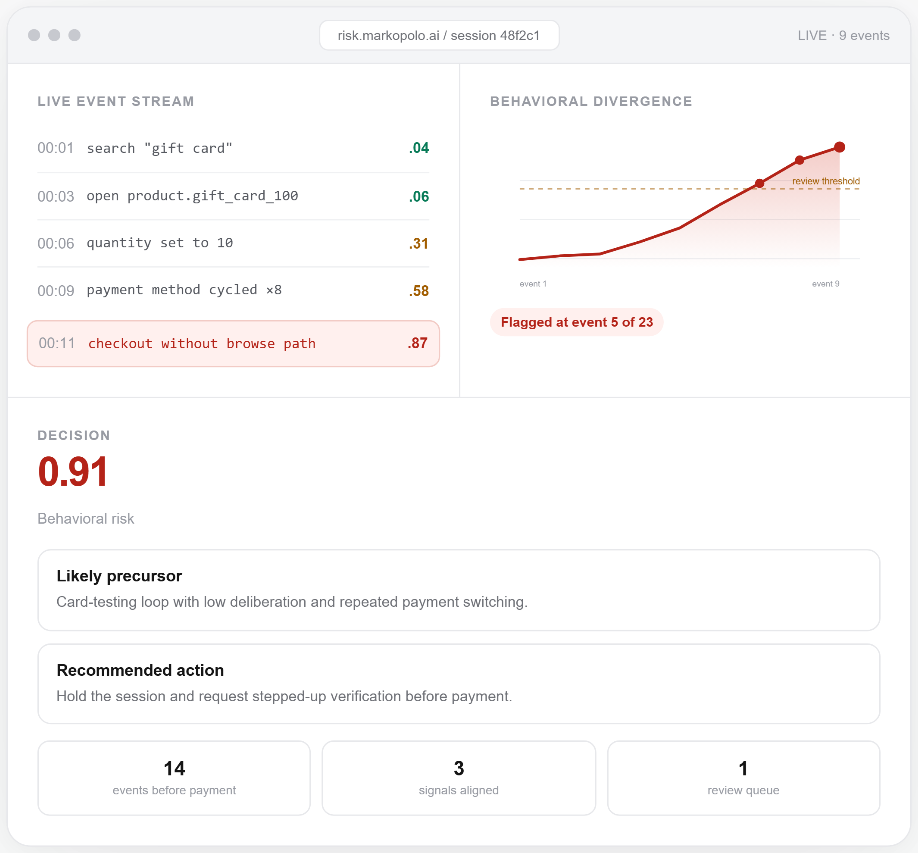
Detect malicious behavior before the transaction.

Fraud leaves a behavioral trace before it leaves a payment trace. A domain-adapted event model can score how far each action diverges from expected human behavior, then surface a rising risk trajectory while there is still time to intervene.

01 / 14 · illustrative concept mockup from the release article mvrko program
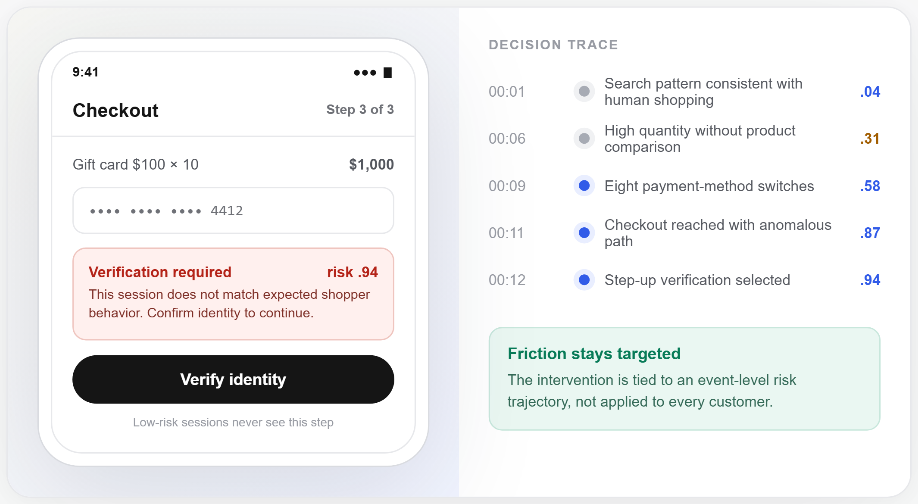
Apply the signal at the moment of payment.

The same divergence score can become an inline checkout decision. Normal sessions keep moving. A session carrying a malicious behavioral signature receives an additional verification step before money or goods leave the system.

02 / 14 · illustrative concept mockup from the release article mvrko program
CUSTOMER ENGAGEMENT
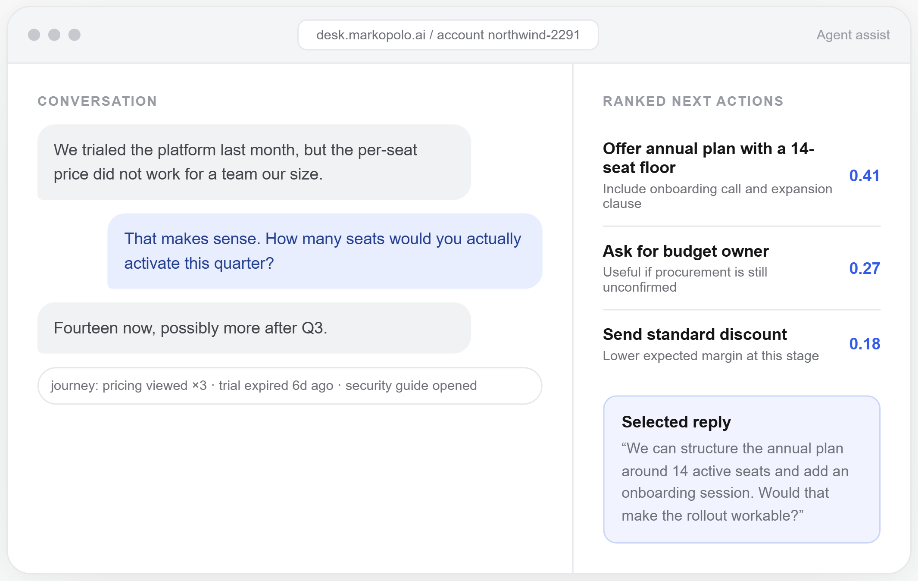
Give customer-facing agents a next-best-action layer.

An agent needs more than a fluent reply. It needs to know what to ask, when to act, and which policy or commercial move fits the current state. The mvrko program is designed to learn those choices from interaction states and verified outcomes.

03 / 14 · illustrative concept mockup from the release article mvrko program
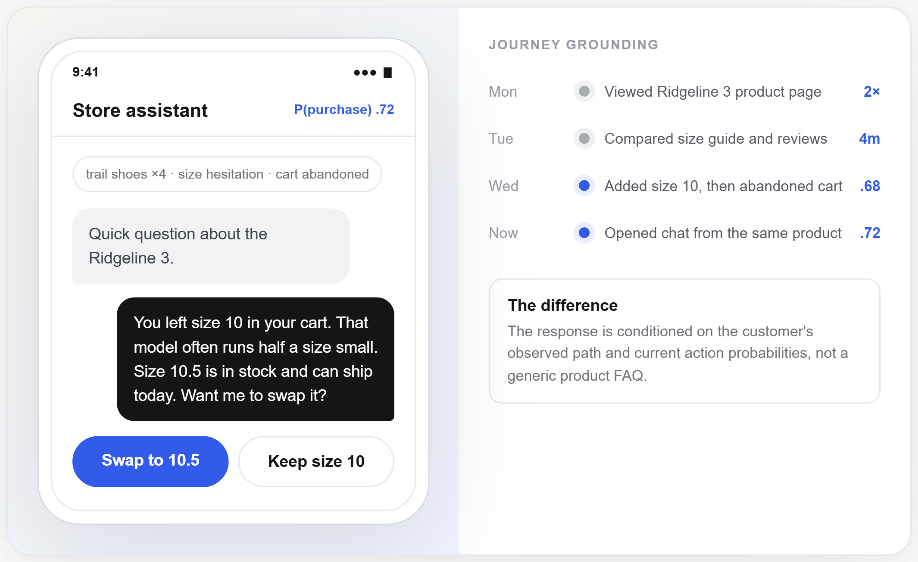
Ground the conversation in the journey, not only the transcript.

A transcript-only chatbot starts at the first message. A journey-aware chatbot can start with what the customer browsed, compared, and abandoned, then use the predicted next event to make the conversation specific from turn one.

04 / 14 · illustrative concept mockup from the release article mvrko program
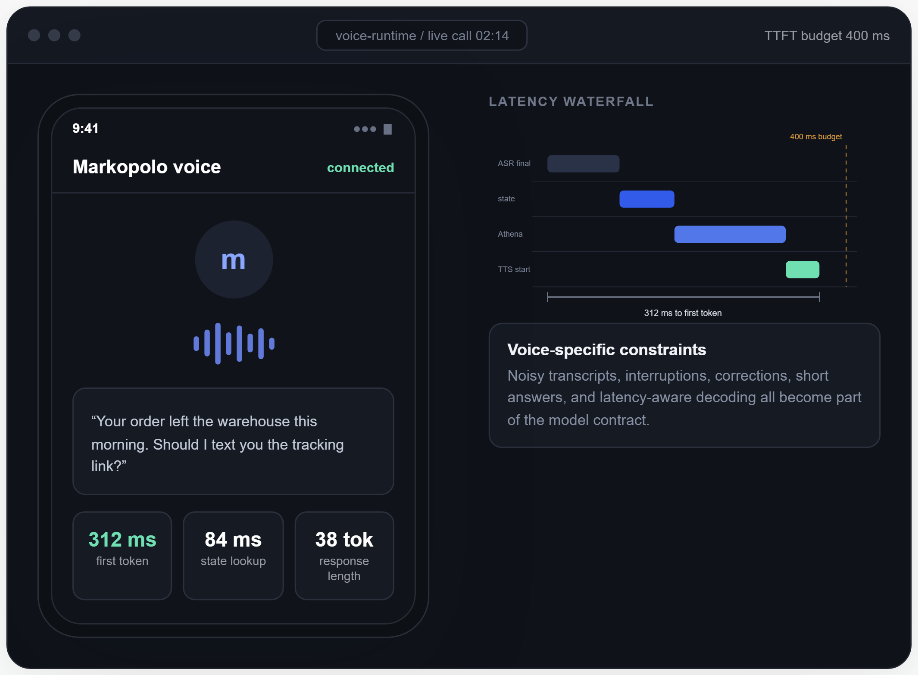
Put a small reasoning engine inside the voice latency budget.

The production target is roughly 400 milliseconds to the first token. That constraint favors a small, specialized, self-hosted model that can reason over customer state without adding a long hosted-model pause.

05 / 14 · illustrative concept mockup from the release article mvrko program
AGENTIC COMMERCE
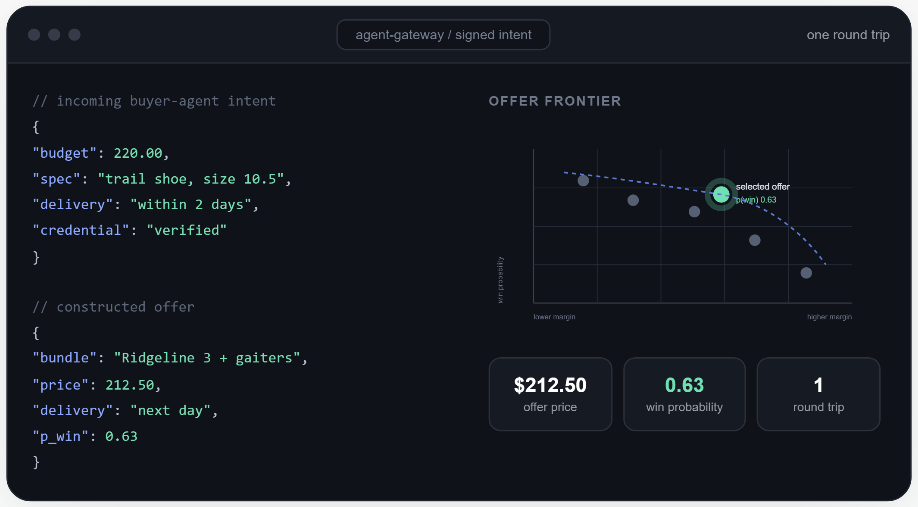
Construct the winning offer in one round trip.

When a buyer agent arrives with explicit constraints, persuasion and retargeting disappear. The merchant must construct the best compliant offer, price it against a calibrated win probability, and respond correctly the first time.

06 / 14 · illustrative concept mockup from the release article mvrko program
CONSUMER BUSINESS
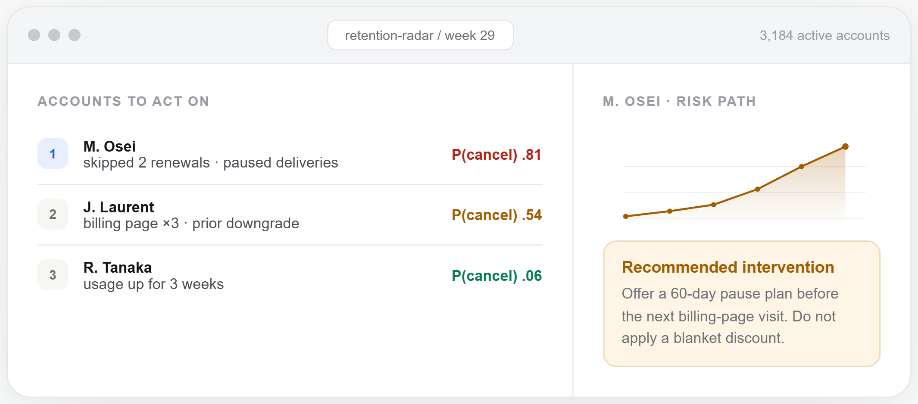
See churn forming before the cancel click.

Subscriptions and direct-to-consumer products generate repeated event paths. A next-event model can identify the path toward pause, downgrade, or cancellation and recommend a targeted save action while the customer is still active.

07 / 14 · illustrative concept mockup from the release article mvrko program
RETAIL
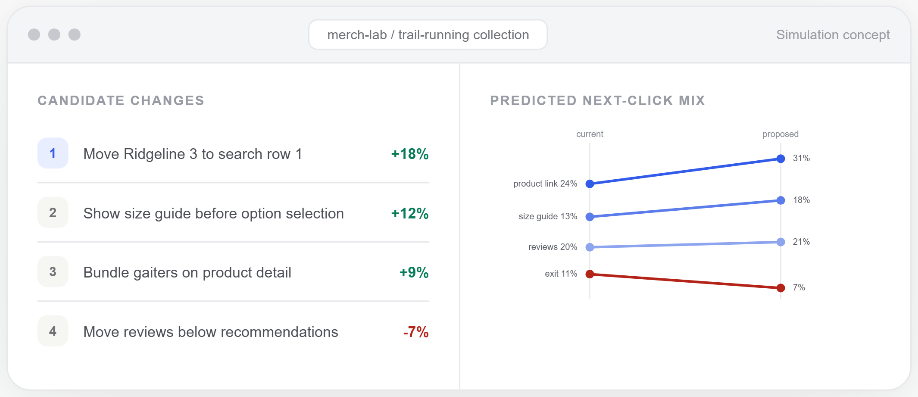
Rank the interface by predicted shopper behavior.

Athena scores candidate actions over a typed page state. That same signal can help a merchandising team compare placements, bundles, and guidance before changing the live storefront.

08 / 14 · illustrative concept mockup from the release article mvrko program
MOBILE APP ECOSYSTEM
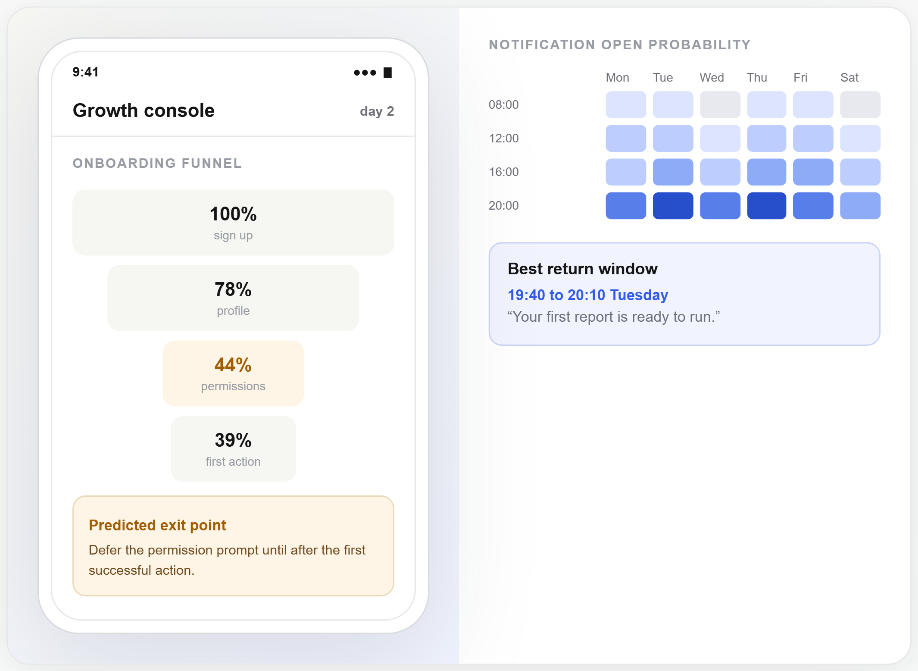
Predict the drop-off step and the right return window.

Mobile app events are another structured sequence. The event-modeling pattern can flag the onboarding step a user is approaching with high abandon probability, then identify a better time for a recovery notification.

09 / 14 · illustrative concept mockup from the release article mvrko program
GAMING ECOSYSTEM
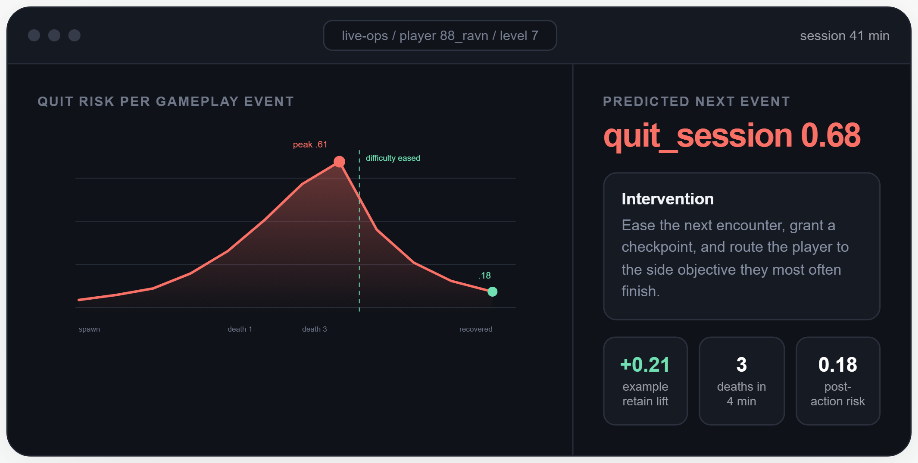
Read the session arc before frustration becomes a quit.

Deaths, retries, idle time, objectives, and store visits form an event stream. A game-specific model can estimate the next event live, then adjust difficulty or content routing while the player is still in the session.

10 / 14 · illustrative concept mockup from the release article mvrko program
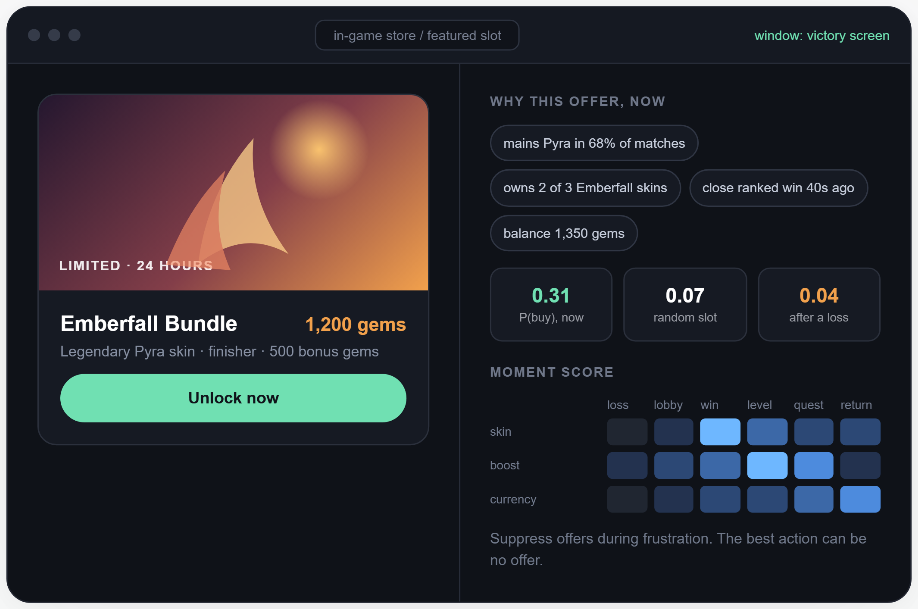
Choose the offer and the moment together.

In-game purchase enhancement is not only a recommendation problem. It is a next-action problem: which item, at which price point, in which session state, and whether the moment is appropriate at all.

11 / 14 · illustrative concept mockup from the release article mvrko program
B2B
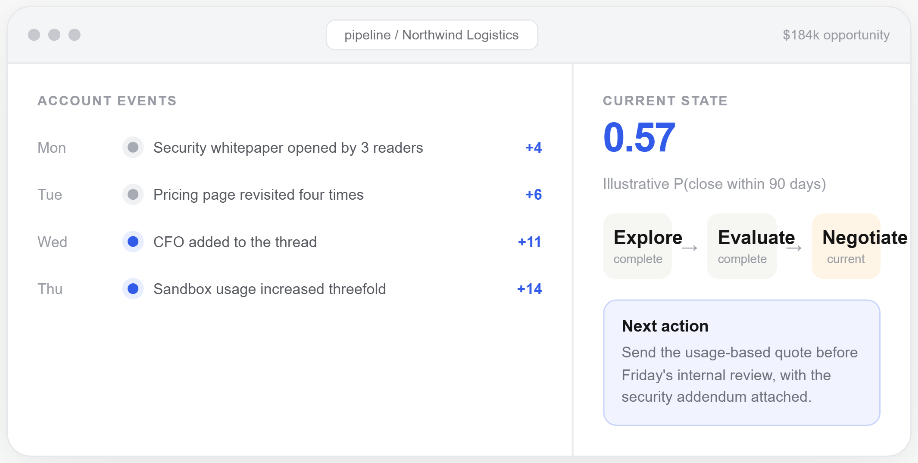
Turn a long account trail into the next commercial move.

A B2B deal is an event sequence distributed across people: documents opened, pricing revisited, stakeholders added, sandbox usage changed. A behavioral model can convert that trail into a stage estimate and ranked next actions.

12 / 14 · illustrative concept mockup from the release article mvrko program
REAL ESTATE AND PROPTECH
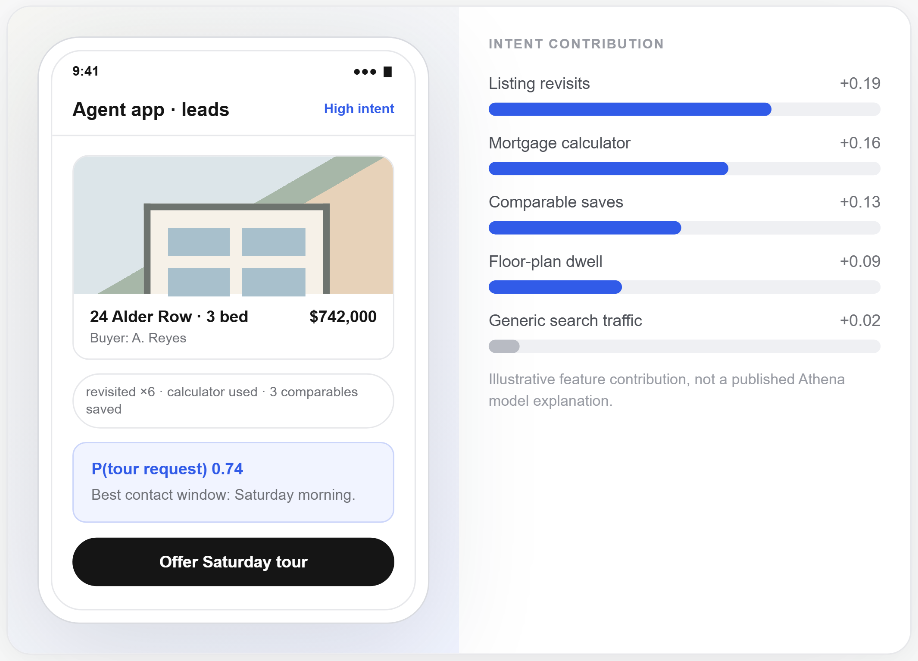
Separate listing traffic from a forming purchase journey.

Revisit cadence, saved comparables, time on floor plans, mortgage-calculator use, and tour behavior create a richer signal than a page view. A next-event system can rank who is likely to request a tour and when outreach is most useful.

13 / 14 · illustrative concept mockup from the release article mvrko program
INSURANCE
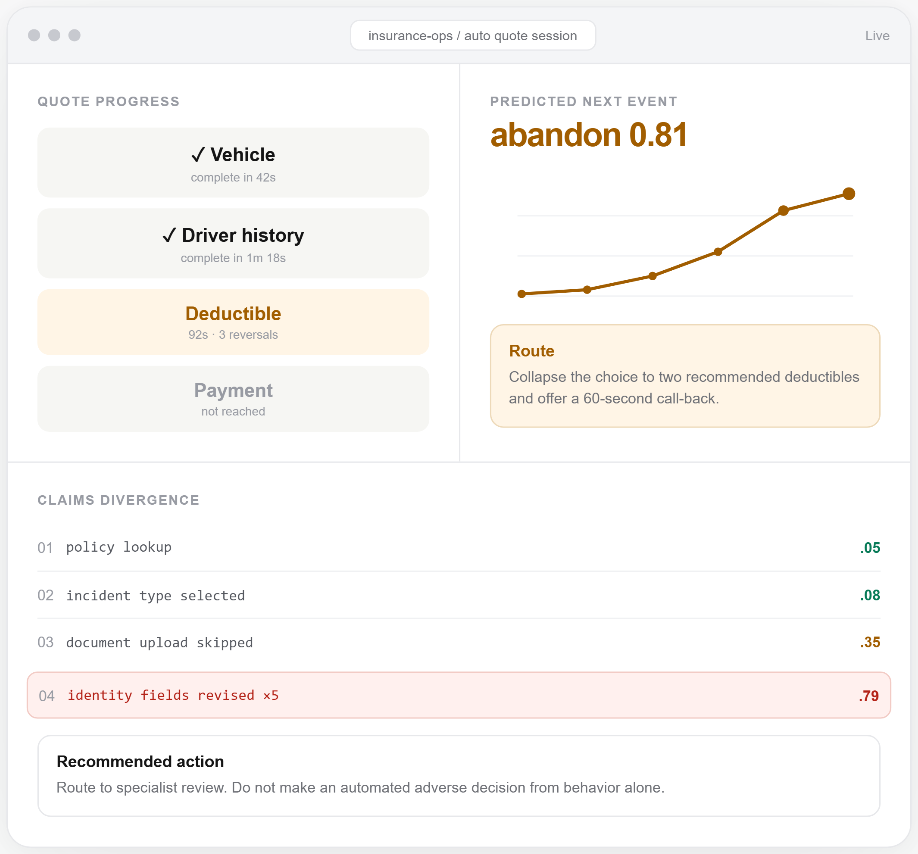
Catch quote abandonment and anomalous claims paths.

Insurance journeys contain predictable high-friction events, such as deductible selection, document upload, and medical questions. The same event-divergence pattern can also flag claims behavior that departs from expected policyholder paths.

14 / 14 · illustrative concept mockup from the release article mvrko program
07 · LIMITATIONS

Strong because the comparison is stated precisely.

Athena is a research release and product foundation, not a public chat model — available first through design partnerships. These constraints belong next to the headline, not hidden behind it.

LIMITATIONS — CLICK TO EXPAND

Build the next customer system on a model that understands events.

Athena is the first release in the mvrko simulation track: a compact behavioral foundation for next-action prediction, journey simulation, and agentic decision systems.

Explore in Hugging face Try Athena